













A dried grapefruit slice is one of the few ingredients that works equally well in a teapot, a cocktail glass and on a dessert plate - but only if it is used the right way. Too hot, too long or too thick, and the same slice that should taste bright and bitter-sweet turns harsh. This guide collects the methods our tea, bar and bakery customers actually use, with ratios, temperatures and timing for each application.
Start With the Right Slice for the Job
Most disappointing results come from using one slice format for every purpose. Our standard slice is 55-65 mm across and 2.5-3.5 mm thick, which suits hot tea, cold brew and garnish. For other uses the cut matters more than the size.
| Application | Best format | Why |
|---|---|---|
| Hot tea and infusions | Whole round slice, 2.5-3.5 mm | Thin enough to rehydrate in minutes, whole enough to look right in the pot |
| Cold brew and iced tea | Whole slice, or half slice for small bottles | Long extraction without bitterness; half slices fit narrow necks |
| Cocktail garnish | Whole slice, on the glass rim or floated | Keeps its round shape and color while sitting in liquid |
| Dessert and platter decoration | Whole slice, lightly rehydrated | Softens enough to cut without losing the silhouette |
| Retail jars and pouches | Whole slices, layered with other citrus | Visual appeal drives the purchase decision on shelf |

Hot Tea: Ratio, Temperature and Time
The safest starting point is one whole slice per 250-300 ml of water at 90-95 degrees Celsius for 3 to 5 minutes. Below 90 degrees the peel oils release slowly and the cup tastes flat; at a rolling boil the pith gives up its bitterness and the drink turns harsh. This is the single most common mistake we see in customer trials.
Because the slice works as both flavor and visual, brew it in a glass pot or a clear cup where the color development is visible. The slice rehydrates to roughly its fresh shape in about 3 minutes, and the water picks up a pale pink-gold color that deepens toward the fifth minute. Pairings that work well in blends:
| Pairing | Ratio per 500 ml | Steep time |
|---|---|---|
| Grapefruit only | 2 slices | 3-5 min |
| With green tea | 1 slice + 3 g leaf | 2-3 min (green tea first) |
| With rooibos or honeybush | 1-2 slices | 5-7 min |
| With hibiscus | 1 slice (hibiscus dominates) | 4-5 min |
| With mint and lemongrass | 1 slice + a few leaves | 3-4 min |
Cold Brew and Iced Tea
Cold extraction is where dried grapefruit behaves most differently from hot brewing. Use one slice per 500 ml of cold water, refrigerate for 6 to 8 hours, then remove the slice. The result is softer and more aromatic than a hot brew that has been chilled, because low temperature pulls the peel aroma without extracting much pith bitterness - which makes cold brew forgiving for high-volume operations.
Two practical notes for iced service: leave the slice in the glass when serving, since the visual is half the value; and if the drink is built over ice, brew the base slightly stronger (1.2 slices per 500 ml) to allow for dilution. For bottled products, half slices fit narrow necks better and dose more predictably than whole rounds.

Cocktails and Bar Garnish
Bars use dried grapefruit in three distinct ways, and each has a different prep. The goal in all three is a slice that looks fresh-cut but does not fall apart in the glass.
- Float garnish: place a dry slice directly on the drink. It rehydrates slowly over 10 to 15 minutes, so it holds its shape through service and looks best in a coupe or a rocks glass.
- Rim and clip: clip a dry slice to the rim. Because it is stiff when dry, it stays in place without a pin - something a fresh slice cannot do.
- Syrup infusion: simmer 6 to 8 slices in 500 ml of simple syrup for 15 minutes off the heat, then strain. The syrup carries grapefruit aroma and a mild bitterness that works in spritz-style drinks; the strained slices can be dried again for garnish.
For high-volume bars, pre-batch the syrup and keep dry slices in a sealed jar at the station. A dry slice also survives a busy service far better than a fresh one, which browns and collapses within hours.
Desserts, Cakes and Platters
On a dessert plate the slice works as edible decoration rather than as a flavoring. Rehydrate it in warm water for 2 to 3 minutes, pat it dry, then use it whole on cakes, tarts and cheese boards - it becomes soft enough to cut with a fork while keeping its round outline. Used dry, the slice is too stiff to eat comfortably and reads as a plastic decoration.
For a frosted look that photographs well, rehydrate, pat dry, brush lightly with water and dust with fine sugar before the surface dries. This works because our slices contain no added sugar or syrup - the coating is entirely yours to control, and the ingredient list on your finished product stays clean.

Five Mistakes That Ruin the Result
| Mistake | What happens | Fix |
|---|---|---|
| Brewing with boiling water | Harsh, pithy bitterness | Hold at 90-95 degrees |
| Steeping past 8 minutes | Bitterness overtakes the aroma | Pull the slice, or brew cold instead |
| Using dry slices in hand-smashed drinks | No peel oils released; flat flavor | Use fresh fruit for that prep, dried for everything else |
| Storing an opened carton in the open | Slices absorb humidity, lose crispness and aroma | Reseal with the liner, keep cool and dry |
| Judging color from the dry slice alone | Color develops in the cup, not on the tray | Always test a brew before approving a batch |
Retail Jars and Gift Sets
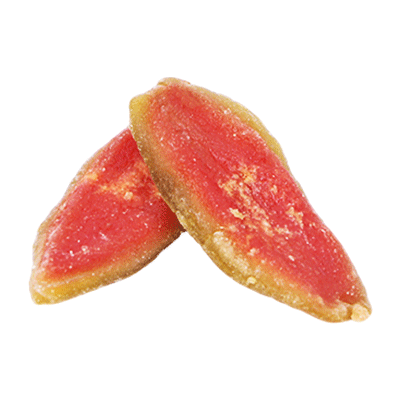
The same slice that decorates a cocktail also sells tea. In retail formats the job is visual: layer whole slices against the glass of a jar so the pink-red flesh reads clearly, then fill the gaps with smaller citrus or herbs. Grapefruit next to orange and lemon creates the color contrast that makes a gift set photograph well - and contrast is what sells on a shelf or in a listing image.
Two packing notes that matter more than they look: keep slices whole for retail (fragments settle at the jar bottom and read as damage), and use a moisture-barrier liner inside the outer carton so jars do not pick up humidity in transit. Brands that sell refill pouches usually keep the same whole-slice format and simply change the pack size.

Sourcing Slices That Behave This Way
Every method above assumes a slice that rehydrates fully in about 3 minutes, keeps its shape in liquid, and carries no sulfur or added sugar. Ours are produced by low-temperature AD drying with a sulfur-free process: moisture below 8%, water activity below 0.6, breakage under 2% after export shipping, packed in 5 kg or 10 kg cartons with a moisture-barrier liner. Each lot ships with a COA and pesticide residue results; phytosanitary, health and origin certificates are available for export.
If you are testing several applications at once, a mixed sample kit is the fastest route: brew one slice hot, cold brew another, and float a third in a glass of sparkling water. Fifteen minutes of testing tells you more than any specification sheet.
Frequently Asked Questions
What water temperature should I use for hot tea?
90-95 degrees Celsius. Boiling water extracts pith bitterness and the cup turns harsh; below 90 degrees the peel aroma releases too slowly.
How many slices per cup or bottle?
One slice per 250-300 ml for hot tea, one per 500 ml for cold brew, and half a slice for small bottles or single-serve packs.
Will the slice fall apart in a cocktail?
No. A dry slice rehydrates gradually, so it holds its round shape through service. It is far more stable than a fresh slice, which browns within hours.
Can I use the slices for baking?
Yes, as decoration. Rehydrate for 2-3 minutes, pat dry, then place on the finished product - baking a dry slice at high heat darkens it and drives off the aroma.
How should I store an opened carton?
Reseal it with the moisture-barrier liner and keep it cool and dry. Slices that absorb ambient humidity lose crispness and aroma, and rehydrate unevenly afterwards.
Do the slices contain sugar or sulfur?
Neither. The slices are dried grapefruit only - no sugar, no preservative, no SO2. Sweetening or frosting is entirely under your control.
Test Three Applications With One Sample Kit
Request a free sample kit of sulfur-free dried grapefruit slices - COA attached - and brew, cold brew and garnish from the same lot.
Request Your Free Sample KitBuying for the first time? Read our buyer's guide to dried grapefruit slices for tea brands for specs, documents and MOQ. For more citrus serving ideas, see 15 creative ways to use dried oranges.


