












Fruit tea menus keep expanding, and grapefruit is the slice that gets asked about most after orange and lemon. It brings a bitter-sweet edge that orange cannot offer, and a pink-red color that photographs well on a tea menu. But buying dried grapefruit slices for tea is not the same as buying them for decoration: the slices must rehydrate properly, keep their color through a 12-month shelf life, and stay consistent from carton to carton. This guide explains what a tea brand should check before placing a bulk order, based on how we actually produce and ship these slices.
Who Buys Dried Grapefruit Slices - and Why
We supply dried grapefruit slices to several different buyer types, and each one checks a different set of specs. Knowing which type you are helps you ask the right questions before you request a quotation.
| Buyer type | What they use the slices for | Spec they care about most |
|---|---|---|
| Herbal and fruit tea brands | Signature blends sold as loose leaf or pyramid bags | Rehydration speed and flavor balance |
| Tea shop chains | In-store brewing and visible fruit in the cup | Slice diameter uniformity and color |
| Private label packers | Retail pouches and gift tins under their own brand | Appearance consistency and shelf life |
| Beverage developers | Cold brew and RTD tea concepts in testing | Flavor strength and documentation |
| Distributors | Reselling bulk cartons to local tea producers | Price stability and container loading |
Grapefruit sits in an interesting position on a tea menu. Lemon is familiar and safe; grapefruit is more distinctive. Brands use it to build blends that taste different from the standard orange-lemon lineup, and the pink flesh color gives the dry blend a premium look on the shelf.

The Specs a Tea Buyer Should Check First
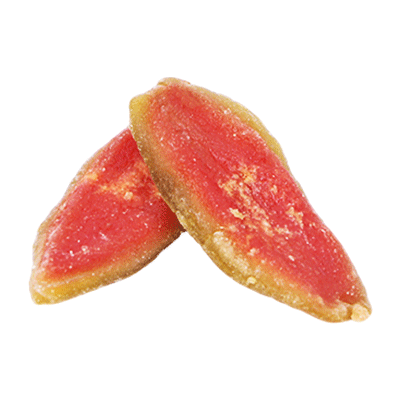
Our standard dried grapefruit slice is an AD (air dried) product made from fresh red grapefruit. The table below lists the specifications we control on every batch, and why each one matters specifically for tea applications.
| Item | Standard spec | Why it matters for tea |
|---|---|---|
| Slice diameter | 55-65 mm (custom sizes on request) | Uniform slices portion accurately into blends and look consistent in the cup |
| Thickness | 2.5-3.5 mm, tolerance within 1 mm | Even thickness means even rehydration across the batch |
| Moisture | Max 8% | Low moisture prevents mold risk inside sealed blend pouches |
| Water activity | Max 0.6 | Key number for a stable 12-month shelf life |
| Color | Natural pink-red flesh, sulfur-free process | Color carries through the dry blend and into the brewed cup |
| Added sugar | None | Ingredient list stays short; blend sweetness is fully controlled by the brand |
| Breakage rate | Max 2% after export shipping | Broken slices end up as dust at the bottom of retail pouches |
| Shelf life | 12 months, cool and dry storage | Covers production, shipping and a full retail cycle |
Rehydration: The Test That Matters Most
A dried grapefruit slice can look perfect in the carton and still fail in the teapot. If the slice was dried too aggressively, it stays stiff, floats as a pale wafer and releases almost nothing into the water. Tea drinkers call these "dead slices", and they are one of the most common complaints in fruit tea reviews.
Our low-temperature drying curve is set so that a slice rehydrates in about 3 minutes in hot water and regains a plump, full-bodied shape. We recommend that every tea buyer run this simple test on a sample before committing to an order: brew one slice in a clear glass at 90 degrees Celsius for 5 minutes, then check whether the flesh has softened through the center and whether the water has taken on both color and a clear grapefruit character. This one test reveals more about the drying process than any certificate.

Bitterness Control and Flavor Balance
Grapefruit's signature bitterness comes mainly from the white pith, and it is the number one reason fruit tea blends get reformulated. We trim the seeds and the thickest part of the pith before drying, which keeps a mild sweet-tart character with the grapefruit identity still clearly present. The goal is a slice that tastes like grapefruit, not a slice that tastes like medicine.
Because bitterness tolerance differs by market, this is a parameter we can adjust for the buyer rather than a fixed property. Before production we agree on a reference sample, and every later batch is produced against that reference so the blend recipe does not need to be rewritten each season.
What You Can Adjust as a Buyer
A common mistake is treating dried fruit as a fixed commodity. In practice most of the parameters that decide whether the slice works in your blend are adjustable, as long as they are agreed before production starts.
| Adjustable parameter | Typical options | Trade-off to know |
|---|---|---|
| Slice size | Whole round slices, half slices, cut pieces for tea bags | Smaller cuts dose easily but lose the visual whole-slice effect |
| Bitterness level | Mild (heavy pith trim) to standard | Heavier trimming reduces the grapefruit character as well |
| Moisture target | 6-8% window | Drier slices last longer but rehydrate slightly slower |
| Packing format | 5 kg / 10 kg export cartons, moisture-barrier liner | Retail-ready packing is possible at higher MOQ |
| Blend supply | Grapefruit only, or mixed fruit slice blends to your ratio | Blends simplify your purchasing but lock the recipe earlier |
Sulfur, Sugar and Label Rules by Market
Dried citrus is traditionally treated with sulfur dioxide to keep the color bright, and this is where many buyers get into trouble at import. Our slices are produced with a sulfur-free low-temperature process, which means no SO2 declaration is needed on the label. This matters most for European clean-label brands, but the advantage applies everywhere: the ingredient list simply reads dried grapefruit.
| Market | What the buyer should confirm | How we support |
|---|---|---|
| European Union | SO2 content against EU limits; clean ingredient list for clean-label positioning | Sulfur-free process plus per-lot COA confirming no added SO2 |
| United States | Ingredient declaration and pesticide residues under FDA import rules | Pesticide residue testing per lot, documents available for review |
| Middle East and Asia | Health certificate and halal requirements where applicable | Health certificate, certificate of origin and halal documentation available |
One responsibility note for private label buyers: claims on the final retail pack are yours to clear. We supply the raw material and the test documents behind it, but wording such as "no added sugar" or market-specific nutrition claims must be checked against your local labeling rules before printing. We are glad to review draft label text against the product documents, and many buyers use this check as a free second pair of eyes before going to print.

Documents and Quality Checks We Provide
Every lot ships with a certificate of analysis covering moisture and water activity, and with pesticide residue test results. For customs clearance we provide the phytosanitary certificate, the health certificate and the certificate of origin. If your market requires halal documentation, it is available as well.
On the buyer side, three inputs make production faster and the result better: your target blend ratio (what percentage of the blend is grapefruit), your preferred slice size, and the reference sample you approve. When these are fixed before production, the first bulk shipment matches the sample instead of triggering a revision round.
How Ordering Works
- Step 1: Send your target spec, slice size and estimated annual volume.
- Step 2: We quote and send a production-grade sample with its COA.
- Step 3: You run the rehydration and flavor test against your blend.
- Step 4: The approved sample becomes the sealed reference for the order.
- Step 5: Bulk production, third-party or in-house testing, and packing.
- Step 6: Shipment with the full document set for customs clearance.
MOQ, Lead Time and Samples
Standard bulk packing starts at 5 kg per carton, and our MOQ for dried grapefruit slices is set so that even a first trial container mix stays economical - many tea brands start with a mixed carton order together with our orange and lemon slices, test their blends, and move to full pallets once the recipe is confirmed. Production lead time is typically 15 to 20 days after sample approval, depending on the season. Sample kits are free; the buyer covers the courier cost. For exact current MOQ and pricing, contact us with your target volume and we will reply with a quotation and the matching specification sheet.

Frequently Asked Questions
Are the slices dried with sulfur dioxide?
No. Our grapefruit slices are dried with a sulfur-free low-temperature process, and each lot's COA confirms the result. The ingredient list is simply dried grapefruit.
How long does a slice take to rehydrate in tea?
About 3 minutes in hot water. We recommend buyers verify this with a sample brew before ordering, since rehydration behavior is the most product-specific property of dried fruit.
Is the bitterness adjustable?
Yes. Pith trimming is set before production, from a mild profile with heavier trimming to a standard profile with more grapefruit character. The agreed sample becomes the reference for all later batches.
Can you supply cut pieces for tea bags?
Yes. Besides whole round slices we can cut half slices or smaller pieces sized for pyramid bags and single-serve portions. Cut pieces dose accurately but lose the whole-slice visual in the cup.
Can I mix grapefruit with other fruit slices in one order?
Yes. Mixed carton orders of orange, lemon and grapefruit slices are common for blend development, and we can also supply a ready-mixed blend to your ratio at higher volumes.
What documents come with a bulk shipment?
COA per lot, pesticide residue test results, phytosanitary certificate, health certificate, certificate of origin, and halal documentation where required.
Test the Rehydration Yourself Before You Commit
Request a free sample kit of our sulfur-free dried grapefruit slices, with the COA attached, and brew it against your own blend before placing a bulk order.
Request Your Free Sample KitBuilding a full citrus tea line? Read our guide to dried orange slices for tea brands and our overview of dried lemon tea to compare how each slice behaves in the cup.


