












Bakery plants and snack manufacturers do not buy dried cherries the way a distributor does. A distributor asks about price per kilo and shelf life; a production manager asks whether the cherry bleeds into the dough, survives the oven, and drops through the dosing unit at the same weight every time. This guide is written for the second group - the specs, cut forms and packing formats that decide whether a cherry works on your line, not just in a sample bowl.
Who Buys Dried Cherries in Bulk
Each application puts a different demand on the fruit, and the failure mode is usually predictable. Knowing which column you sit in tells us which specification to quote before you ask.
| Application | Usual cut form | What typically goes wrong |
|---|---|---|
| Bread, buns and panettone | Whole or halves | Color bleed into pale crumb, fruit sinking to the base |
| Muffins, scones, cookies | Halves or 6 mm dice | Pieces drying hard at the surface, uneven distribution per unit |
| Cereal, granola and bars | 4 to 6 mm dice | Fines and clusters, sticky mass during mixing |
| Trail mix and snack packs | Whole, seedless | Clumping in the bag, migration of moisture to nuts |
| Confectionery and ice cream inclusions | Dice or paste | Freeze-thaw weeping, color migration into the base |
| Distributors and repackers | Whole, bulk carton | Caking in the carton after a long sea freight |

Sweet or Tart: A Purchasing Note
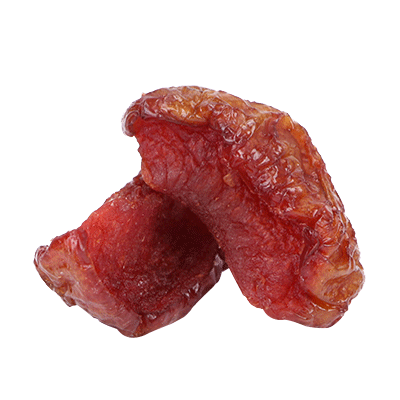
The sweet and tart question is usually framed as a flavor choice, but for industrial buyers it is a formulation decision, because the two behave differently in a batter. Our standard product is a seedless, candied (infused) soft dried sweet cherry - dark red, plump, with a soft bite. Tart cherries, by contrast, bring acidity that can balance a sweet crumb but also interact with leavening and dairy in ways that need a trial bake.
| Type | Behavior in application | Where it earns its place |
|---|---|---|
| Sweet, candied, seedless | Soft bite, holds shape, sweetness carries through baking | Snack mixes, cereal, confectionery, bread |
| Tart (Montmorency type) | Sharper acidity, softer flesh, more prone to bleed | Muffins, scones, pies where acidity cuts richness |
One labeling point worth settling early: our standard cherry is an infused (candied) product, so sugar appears in the ingredient list and the nutrition panel reflects it. If your brief requires a different infusion level or a non-infused dried cherry, raise it at the quotation stage - the specification and the label declaration change together, and retrofitting either one after artwork is printed is expensive.
Cut Forms and Piece Size
Cut form controls two things at once: how the fruit reads in the finished product, and how evenly it doses. The forms below are what we produce most often; sizes outside these are possible but need to be agreed before the batch is scheduled.
| Cut form | Description | Best fit |
|---|---|---|
| Whole, seedless | Full fruit, pitted, soft dried | Trail mix, gift packs, panettone |
| Halves | Cut once, size sorted | Muffins, scones, cookies, bread |
| Dice 6 mm | Cubed, fines screened out | Cereal, granola, bars, cookies |
| Dice 4 mm | Fine dice for even dispersion | Bars, clusters, fillings, ice cream |
| Paste | Milled, for inclusion in dough or filling | Fillings, confectionery, swirls |
Ask for the fines figure when you request a diced quotation. A dice specification without a fines limit is only half a specification - fines are what cause clumping, uneven weight per package and burned specks on the surface of a bake.
Four Behaviors That Decide Whether a Cherry Works on Your Line
Most complaints about dried cherries are not about flavor. They come from four physical behaviors, and each one can be addressed before the order is placed rather than after the first production run.
| Behavior | What you see on the line | How to control it in the spec |
|---|---|---|
| Color bleed | Pink staining in pale crumb, swirled batter, colored ice cream base | Ask for a bleed test, choose a lower-moisture dice, reduce sugar infusion where the recipe allows |
| Bake loss | Fruit turning hard, leathery or slightly burnt on exposed surfaces | Rehydrate or coat before baking, or specify a softer, higher-moisture grade for surface decoration |
| Clumping | Solid blocks in the carton, fruit that will not feed through the hopper | Specify the moisture window, an anti-caking step and a moisture-barrier liner; confirm the carton's compression strength for sea freight |
| Freeze-thaw weeping | Syrup pooling in frozen dough, soggy pockets after bake | Run a freeze-thaw trial on the sample lot before scaling; specify a drier dice for frozen dough programs |

Standard Specification Sheet
The table below is the base specification we work from. Every number is confirmed per lot on the certificate of analysis, and any deviation you need should be raised before the batch is scheduled.
| Item | Standard |
|---|---|
| Product type | Seedless candied soft dried sweet cherry |
| Moisture | Controlled to a defined window, stated per lot on the COA |
| Water activity | Held below 0.65 to limit caking and spoilage risk |
| Cut forms | Whole, halves, 6 mm dice, 4 mm dice, paste |
| Foreign matter | Pits removed, metal detected, visual inspection before packing |
| Shelf life | 12 months in cool, dry storage, unopened |
| Certifications | ISO, Halal, Kosher; FDA registered facility |

Packing: Bulk Cartons and Retail Bags
Candied fruit is heavier and stickier than most dried fruit, so packing is not a formality. Our standard bulk format is a 10 kg carton with a moisture-barrier liner inside, which keeps the fruit from picking up humidity in transit and limits caking at the bottom of the box. For buyers who sell to retail, we also pack sealed retail bags from 50 to 150 g, printed with your logo and label design - the same grade goes into both formats, so a product you validated in bulk behaves identically in a retail bag.
If you are moving from one channel to the other, mixed shipments are possible: bulk cartons for production plus a retail SKU for market testing, on the same pallet. It is a common way to launch a private label line without committing a full container to an unproven pack size.

Documents, Testing and Label Responsibility
Each lot ships with a certificate of analysis covering moisture, water activity and micro results, and we issue the phytosanitary certificate, health certificate and certificate of origin for clearance. Three items deserve a decision before you order:
- Sulphite declaration: some candied fruit programs use sulphites for color retention. If your market sets a limit or your brief requires a sulphite-free position, state it at quotation so the correct material is selected and the label text matches.
- Sugar declaration: an infused cherry carries sugar in the ingredient list and nutrition panel. The exact wording and rounding follow your market's rules, and your label designer should build from the specification we confirm.
- Additional test panels: pesticide residue and any customer-specific panels can be added, but the sampling has to happen before packing, not after the container is closed.
Where our responsibility ends: we supply accurate specifications, test results, documents and the label exactly as approved. Confirming that the finished label and any claims comply with your destination market - and registering the product where required - stays with the importer. We prefer to state this line at the start of a relationship rather than have it surface at customs.
How an Order Runs
- 1. Brief: application, cut form, quantity, destination market and any sulfite or infusion requirement.
- 2. Quotation: pricing for the exact configuration, including packing and private label cost.
- 3. Samples: physical samples of the quoted cut form, plus a reference lot if you need to compare against your current supplier.
- 4. Trial bake: you run a production trial - bleed, bake loss and dosing are checked at this stage, not after the container arrives.
- 5. Production and artwork: batch scheduled after approval; for private label, printing starts only on a confirmed dieline proof.
- 6. Shipment: documents issued before departure, tracking shared until arrival.
MOQ, Lead Time and Samples
Bulk orders in 10 kg cartons start from a single pallet, which lets a bakery or snack plant trial the fruit on the line before committing to a container. Diced forms carry a slightly higher minimum than whole fruit because the cutting step generates a fixed setup loss, and private label retail bags carry a higher minimum again because of the print run. A 20 ft container of 10 kg cartons is the usual benchmark for distributors planning freight, and mixed configurations are negotiable for buyers testing two channels.
Production lead time is normally 15 to 20 days after sample and specification approval, with diced and private label orders at the longer end. Sample kits are free; the buyer covers courier cost.
Frequently Asked Questions
What is the MOQ for bulk dried cherries?
Bulk orders in 10 kg cartons start from a single pallet. Diced forms and private label retail bags carry higher minimums because of cutting setup and print run costs. Exact figures are confirmed at quotation.
Do your cherries bleed color into dough?
Some migration is normal for an infused cherry, especially in high-moisture batters. A lower-moisture dice and a reduced infusion level limit it, and we can provide a sample lot for a bleed test in your own recipe before you commit.
Are the cherries sweetened or infused?
Our standard product is a candied (infused) seedless soft dried sweet cherry, so sugar appears in the ingredient declaration. Different infusion levels can be discussed at quotation if your formulation needs them.
Can you supply a diced cut with a fines limit?
Yes. Diced forms are screened, and the fines limit is agreed in the specification and checked on the lot. We recommend setting it before the first order rather than after a dosing problem appears.
How should bulk cartons be stored after arrival?
Keep cartons closed in a cool, dry store away from strong odors and direct sunlight. Once a liner is opened, reseal or decant into an airtight container; exposed fruit picks up humidity and starts to cake within days.
Which documents come with the shipment?
A certificate of analysis per lot, plus the phytosanitary certificate, health certificate and certificate of origin for customs clearance. Additional panels such as pesticide residue can be arranged before packing.
Trial the Cut Before You Commit to the Container
Tell us your application and cut form - we will send free samples of the exact specification, in whole, halves or diced, so your line can test bleed, bake loss and dosing first.
Request Your Free Sample KitFor the difference between the dried and fresh fruit itself, see our note on dried cherry versus fresh cherry, and for another berry item in the same range, our guide to dried blueberries.


